



Bone loss rarely means that an implant is impossible. The bone can be built up with a bone graft, in the upper back jaw the floor of the sinus can be raised (sinus lift), and for a full arch the implants are placed at an angle, so a graft is usually not needed. At TB Dent in Trebinje a bone graft is rarely necessary, and it costs €102 (200 KM) per gram of bone. What is possible in your case shows on a CBCT scan, which you can send us before you travel.
Why do you lose bone after losing a tooth?
The jawbone shrinks after a tooth is removed, because there is no longer a root putting load on it. Every month of waiting means more bone is lost. That is also why a denture fits worse over time: the bone underneath it keeps shrinking.
The longer a gap stays open, the more likely it is that you will need a bone graft before an implant. But the decision is not lost: even people who have worn a denture for years can later move to fixed teeth on implants.
What does "not enough bone" actually mean?
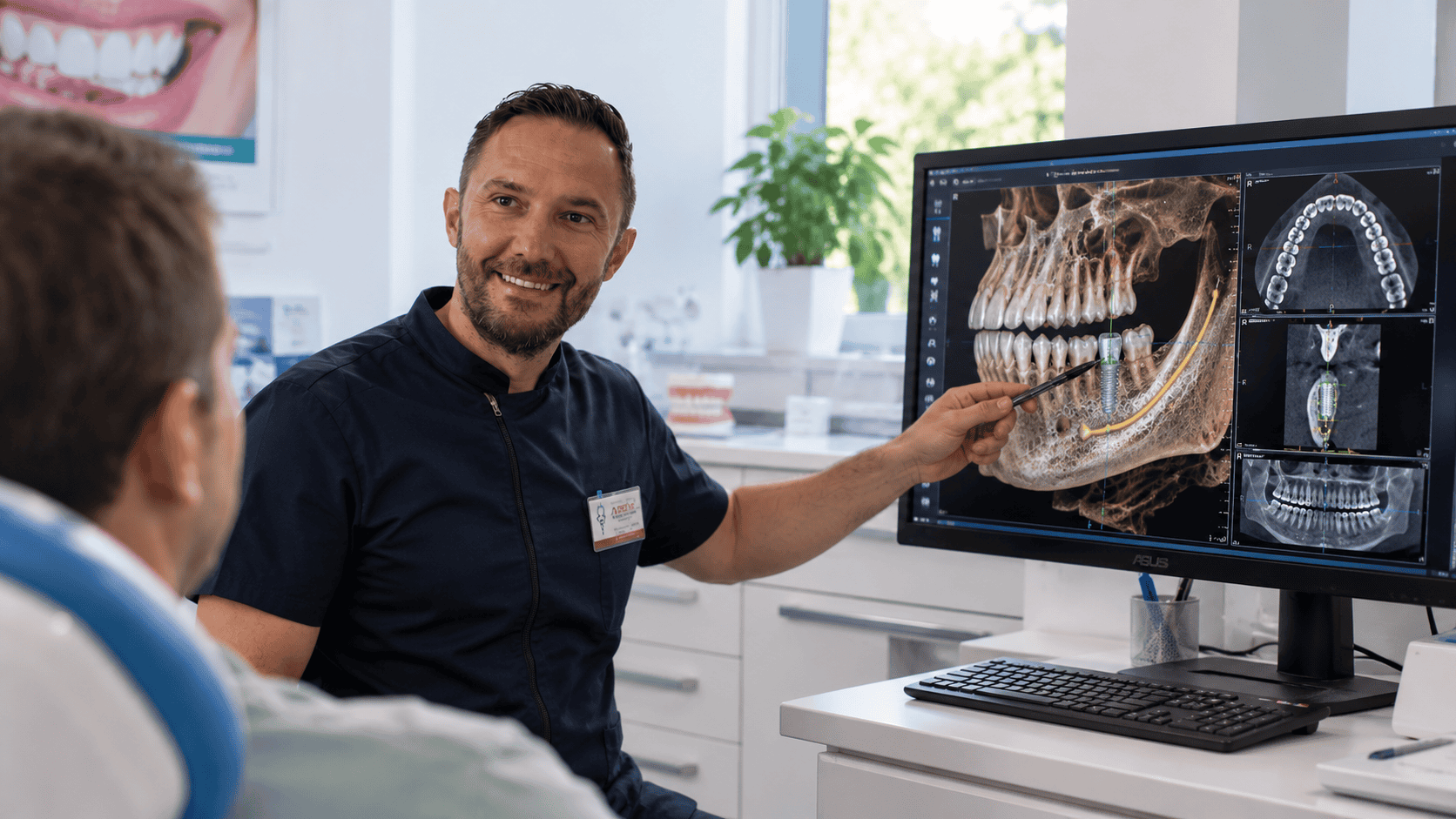
It means the jawbone is not high, wide or dense enough for an implant to sit firmly in it. You can only see this on a three-dimensional CBCT scan, not on an ordinary X-ray. From the scan, the surgeon can tell whether the implant can go in straight away, whether a bone graft is needed, or whether there is a solution that avoids one.
When do we not place implants?
At TB Dent we do not place implants in patients with osteoporosis treated with bisphosphonates, uncontrolled diabetes, during pregnancy, in cancer patients during treatment, in people under 18, or when bone density is very low (below 150 HU, type D5). Smoking does not rule implants out, but it raises the risk, and we talk about it before treatment.
Can you lose bone around an implant later?
A small initial loss of up to 1 mm around an implant is normal. After that it varies from person to person, and it depends a great deal on your oral hygiene and on the quality of the crown or bridge on the implant. That is one reason regular check-ups matter after treatment.
When is a bone graft needed, and what does it cost?
A bone graft adds bone material where bone is missing, so that the implant has a firm base. It is unavoidable when there is not enough bone to keep the implant stable. At TB Dent that is rarely the case, and it costs €102 (200 KM) per gram of bone.
Whether you need one, and how much, the surgeon sees on the CBCT and writes into your treatment plan, so you know the exact price before the procedure. The graft is paid together with the surgical part, when the implants are placed. A single implant with a porcelain-fused-to-metal crown costs €869 (1,700 KM) at TB Dent; a graft is added only if it is needed.
What an implant costs without a bone graft is in Dental implant cost.
Is the bone graft done at the same time as the implant?
Often, yes. When there is enough bone to hold the implant firmly and only a small part is missing, we place the implant and add the missing bone in the same procedure, using bone substitute and a membrane. When there is too little bone or the defect is large, we build up the bone first. The implant then follows six to nine months later, once the new bone is firm. We use either your own bone or Straumann XenoGraft, a bone substitute.
Does a bone graft hurt?
A bone graft is done under local anaesthesia, just like placing an implant, so you do not feel pain during the procedure.
What is a sinus lift, and who needs one?
A sinus lift raises the floor of the sinus above the upper back teeth to make room for an implant. It is only needed in the upper jaw at the back, when the sinus sits low and too little bone is left beneath it. At TB Dent a sinus lift is rarely necessary and costs €102 (200 KM).
Whether the implant can go in during the same procedure depends on how much of your own bone is left under the sinus. With 4 to 5 mm, we place the implant together with the sinus lift, and it heals for four to six months. With only 3 to 4 mm, the sinus lift comes first. We place the implant six to nine months later, and it then needs about another three months to heal.
Can you get implants without a bone graft?
For a full arch, usually yes. With All-on-4, the two back implants are placed at an angle so that they bypass the area without bone and the sinus. That is the whole idea of All-on-4, and it is why most of our patients do not need a bone graft. All-on-4 costs €5,110 (10,000 KM) per jaw at TB Dent. The honest downsides are in All-on-4 disadvantages.
If there is only enough bone for two implants, the solution is a denture held by two implants. It costs €3,068 (6,000 KM) and holds far more securely than an ordinary denture.
We do not place zygomatic implants, which are anchored in the cheekbone. When they are the only option, we refer you to colleagues in Sarajevo or Mostar.
What does a bone graft mean for your trip to Trebinje?
Implant treatment at TB Dent usually means two trips, because implants need three to four months to fuse with the bone. After a single implant you can fly the next day, and after All-on-4 two days after the procedure. After a bone graft, don't fly for at least 7 to 10 days, until the stitches are out, and after a sinus lift for 15 to 20 days. If the bone is built up in a separate procedure, the implant follows six to nine months later, so treatment takes longer. More on this in Flying after dental implants.
That is why it pays to send your CBCT before you book: you will know whether you need a graft before you plan flights and accommodation.
How can you find out how much bone you have before you travel?
If you already have a CBCT scan, send it to us on WhatsApp. The remote consultation is in English and is led by the doctor who places the implants. You get a proposal: whether the implant can go in straight away, whether a graft is needed and what it would cost. If you do not have a CBCT, it is taken at a partner imaging centre next to the clinic and paid separately.
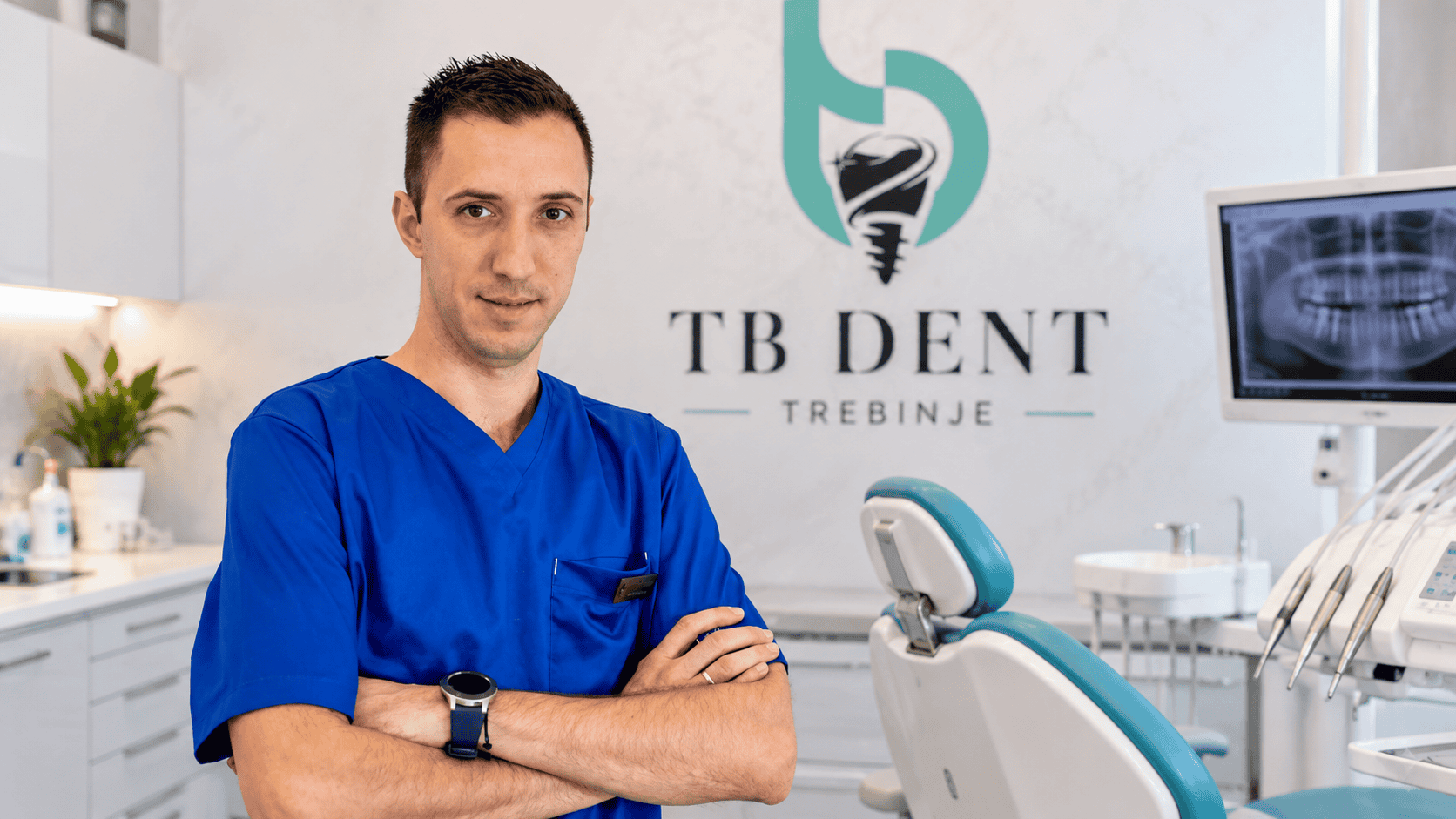
The surgery is performed by Dr Darijo Pandžić, a specialist in oral surgery who places about 300 implants a year. How to get to Trebinje, 40 minutes from Dubrovnik, and what the whole treatment involves is in our guide to dental tourism in Bosnia and Herzegovina. This article is also available in German.
Common questions about dental implants and bone loss
What if I don't have enough bone for an implant?
The bone can be built up with a graft, a sinus lift can be done in the upper back jaw, and for a full arch the implants are placed at an angle, so a graft is usually not needed. A CBCT scan shows what is possible.
How much does a bone graft cost at TB Dent?
€102 (200 KM) per gram of bone, and a sinus lift €102 (200 KM). Both are rarely needed.
Is the bone graft done at the same time as the implant?
Often, yes: when there is enough bone to hold the implant firmly and the defect is small. When there is too little bone or the defect is large, the graft comes first and the implant follows six to nine months later.
When can I fly after a bone graft or sinus lift?
After a bone graft, not for at least 7 to 10 days, until the stitches are out. After a sinus lift, not for 15 to 20 days. After a single implant without either, you can fly the next day.
Do you need a bone graft for All-on-4?
Most patients do not, because the back implants are placed at an angle and bypass the area without bone. A graft is unavoidable only when there is not enough bone for stability or the sinus sits low.
Is it too late for an implant if the tooth has been missing for years?
Usually not. The longer the gap, the more bone is lost and the more likely a graft becomes. Even after years with a denture, moving to fixed teeth is possible.
Does a bone graft hurt?
Not during the procedure, because it is done under local anaesthesia.
Can I find out before I travel whether I need a bone graft?
Yes. Send us your CBCT scan on WhatsApp, and you get a proposal with a price before you book flights and accommodation.